.
先贴题目……这题目犯了个小错误……记下来……
The dog task
| **Time Limit:** 1000MS | **Memory Limit:** 10000K | |||
| **Total Submissions:** 1394 | **Accepted:** 595 | Special Judge | ||
Description
Hunter Bob often walks with his dog Ralph. Bob walks with a constant speed and his route is a polygonal line (possibly self-intersecting) whose vertices are specified by N pairs of integers (Xi, Yi) ? their Cartesian coordinates.
Ralph walks on his own way but always meets his master at the specified N points. The dog starts his journey simultaneously with Bob at the point (X1, Y1) and finishes it also simultaneously with Bob at the point (XN, YN). Ralph can travel at a speed that is up to two times greater than his master’s speed. While Bob travels in a straight line from one point to another the cheerful dog seeks trees, bushes, hummocks and all other kinds of interesting places of the local landscape which are specified by M pairs of integers (Xj’,Yj’). However, after leaving his master at the point (Xi, Yi) (where 1 <= i < N) the dog visits at most one interesting place before meeting his master again at the point (Xi+1, Yi+1). Your task is to find the dog’s route, which meets the above requirements and allows him to visit the maximal possible number of interesting places. The answer should be presented as a polygonal line that represents Ralph’s route. The vertices of this route should be all points (Xi, Yi) and the maximal number of interesting places (Xj’,Yj’). The latter should be visited (i.e. listed in the route description) at most once.
An example of Bob’s route (solid line), a set of interesting places (dots) and one of the best Ralph’s routes (dotted line) are presented in the following picture:
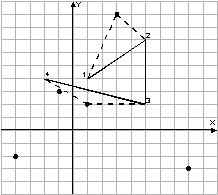
Input
The first line of the input contains two integers N and M, separated by a space ( 2 <= N <= 100 ,0 <= M <=100 ). The second line contains N pairs of integers X1, Y1, …, XN, YN, separated by spaces, that represent Bob’s route. The third line contains M pairs of integers X1’,Y1’,…,XM’,YM’, separated by spaces, that represent interesting places. All points in the input file are different and their coordinates are integers not greater than 1000 by the absolute value.
Output
The first line of the output should contain the single integer K ? the number of vertices of the best dog’s route. The second line should contain K pairs of coordinates X1’‘,Y1’’ , …,Xk’‘,Yk’’, separated by spaces, that represent this route. If there are several such routes, then you may write any of them.
Sample Input
4 5
1 4 5 7 5 2 -2 4
-4 -2 3 9 1 2 -1 3 8 -3
Sample Output
6
1 4 3 9 5 7 5 2 1 2 -2 4

题目意思绕了一大通,实际上是个简单的二分图匹配……构图比较麻烦。大概就是1到n-1号表示从第i个点到i+1点,n+1到n+m表示第i-n个“好玩的地方”,然后如果主人经过这两个点的时间狗来得及逛这个好玩的地方就加一条边……然后就是二分图匹配……
构图的时候犯了个小错误……WA了几次才找出来……一开始为了节约一个sqrt然后直接把
        length1 = sqrt(sqr(route[i].x-route[i+1].x)
                +sqr(route[i].y-route[i+1].y));
        for(j=1; j<=m; j++){
            length2 = sqrt(sqr(route[i].x-place[j].x)
                    +sqr(route[i].y-place[j].y))
                    +sqrt(sqr(route[i+1].x-place[j].x)
                    +sqr(route[i+1].y-place[j].y));
            if(length2 <= length1*2)
                a[i][n+j] = a[n+j][i] = 1;
写成
        length1 = sqr(route[i].x-route[i+1].x)
                +sqr(route[i].y-route[i+1].y));
        for(j=1; j<=m; j++){
            length2 = sqr(route[i].x-place[j].x)
                    +sqr(route[i].y-place[j].y)
                    +sqr(route[i+1].x-place[j].x)
                    +sqr(route[i+1].y-place[j].y);
            if(length2 <= length1*2)
                a[i][n+j] = a[n+j][i] = 1;


还以为结果一样对……然后改的时候继续犯迷糊,把下面的两倍改成4倍……然后有点醒悟,把sqrt加上去了……但是length2的sqrt竟然忘了加……不过所幸这次发现错误没花多久时间……直接静态的看代码就发现错误了……没有到出动GDB的程度还万幸……